GEOPROBE DRILLING & GROUNDWATER WELL NETWORKS
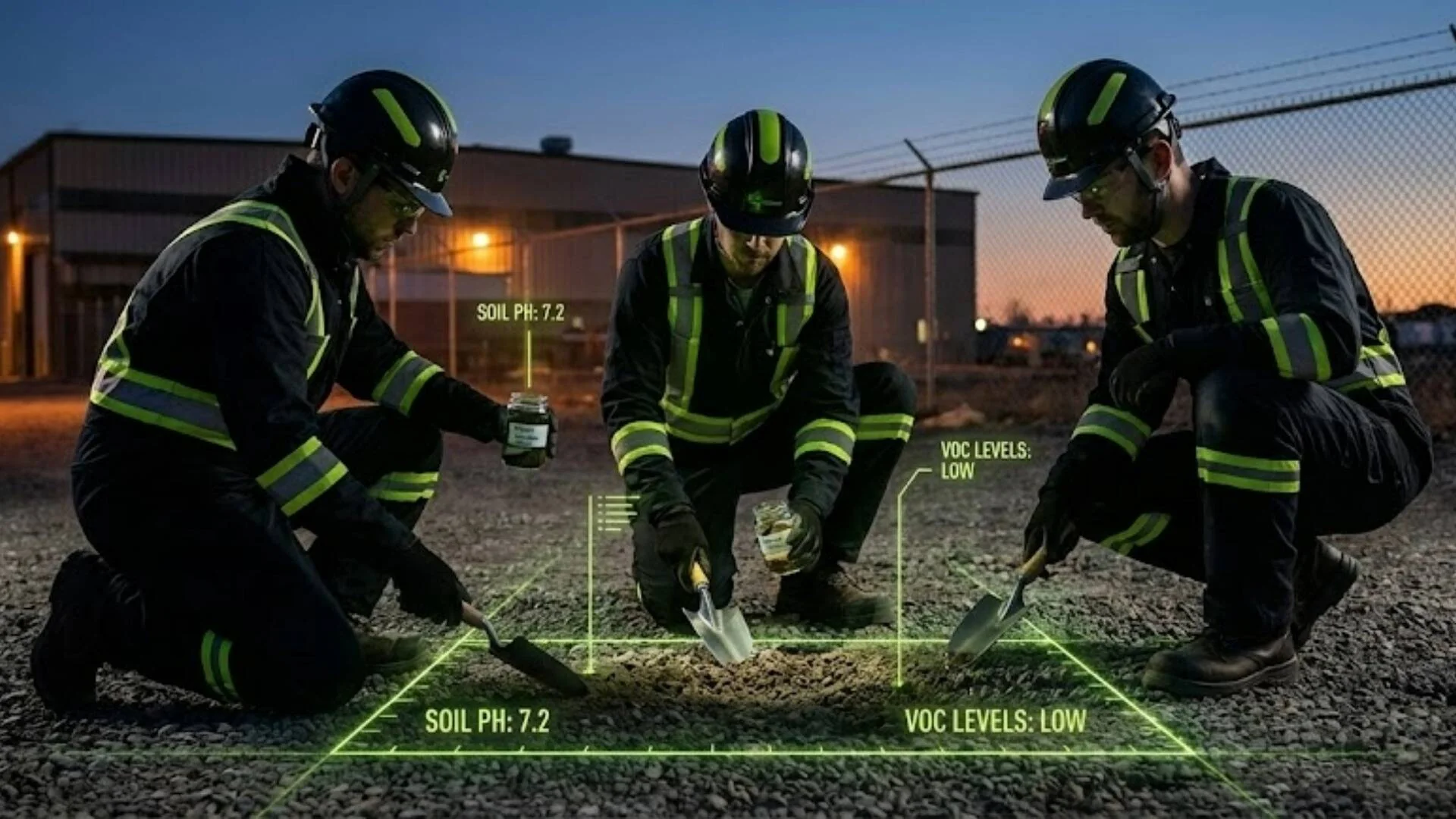
When a Phase I ESA identifies a Recognized Environmental Condition (REC), guesswork must be replaced with empirical chemistry. Envirogyn deploys track-mounted Geoprobe direct-push hydraulic rigs to extract undisturbed soil cores, install groundwater monitoring networks, and collect vapor intrusion samples with minimal surface disturbance.

Continuous Macro-Core Soil Borings
Extracting continuous 4-foot or 5-foot soil cores in disposable PETG liners down to 15–30+ feet below ground surface (bgs). Certified environmental geologists perform Unified Soil Classification System (USCS) lithologic logging and photoionization detector (PID) headspace field screening at 0.1 ppm sensitivity.
- • Undisturbed lithology: Beaumont clay, sand lenses, silt stratification
- • PID 10.6 eV lamp screening to isolate highest volatile hydrocarbon intervals
- • Zero-headspace En Core / Terra Core preservation for volatile organics (EPA 5035A)
Monitoring Wells & Vapor Probes
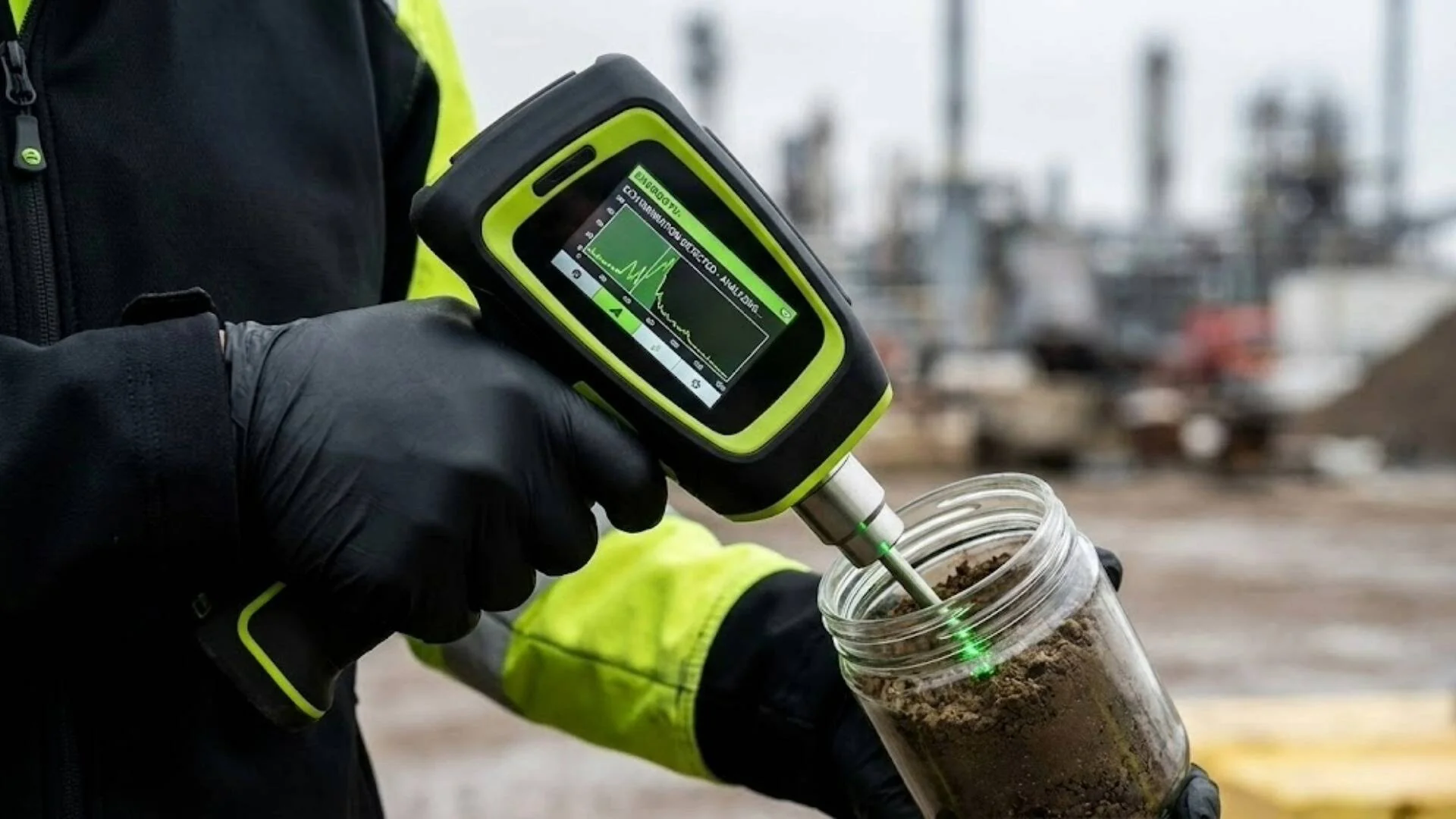
Installing temporary hydropunch samplers or permanent 2-inch Schedule 40 PVC monitoring wells. Sampling via low-flow peristaltic pumps with field parameter stabilization (pH, DO, ORP, turbidity, conductivity) under strict EPA Low-Flow protocols.
- • Water table gauging and gradient flow direction calculation
- • Sub-slab soil vapor pins for TO-15 passivated 6-Liter Summa canisters
- • Helium shroud real-time leak testing to guarantee sample integrity
THE 5 TARGET CONTAMINANT PANELS
All samples are dispatched under unbroken, tamper-evident Chain of Custody to state-certified NELAP environmental chemistry testing benches. Data is delivered in court-defensible Level II through Level IV quality control validation packages.
Volatile Organic Compounds (VOCs)
Full scan for gasoline hydrocarbons, chlorinated solvents, and industrial degreasers:
- • Benzene, Toluene, Ethylbenzene, Xylenes (BTEX)
- • Tetrachloroethene (PCE / "Perc" dry cleaner solvent)
- • Trichloroethene (TCE / degreaser) & cis-1,2-DCE
- • Vinyl Chloride (toxic breakdown metabolite)
- • Methyl Tert-Butyl Ether (MTBE)
Total Petroleum Hydrocarbons (TPH)
Texas state-specific carbon fraction fingerprinting for fuel oils and underground tanks:
- • C6–C12 Gasoline Range Organics (GRO)
- • >C12–C28 Diesel Range Organics (DRO)
- • >C28–C35 Heavy Lube Oil & Motor Oil Range
- • Total Hydrocarbon Summation under TRRP PCLs
- • Silica Gel Cleanup option for biogenic interference
Semi-Volatiles & PAHs (SVOCs)
Heavy industrial distillates, creosote, coal tars, and chemical manufacturing residues:
- • Polycyclic Aromatic Hydrocarbons (PAHs)
- • Benzo(a)pyrene, Chrysene, Fluoranthene
- • Naphthalene & 2-Methylnaphthalene
- • Phenols, cresols, and chlorinated benzenes
- • Polychlorinated Biphenyls (PCBs via EPA 8082A)
RCRA 8 Heavy Toxic Metals
Inductively Coupled Plasma Mass Spectrometry (ICP-MS) and Cold Vapor Mercury analysis:
- • Arsenic (As) • Lead (Pb) • Cadmium (Cd)
- • Chromium (Total & Hexavalent Cr VI)
- • Mercury (Hg) via Cold Vapor atomic absorption
- • Barium (Ba) • Selenium (Se) • Silver (Ag)
- • Synthetic Precipitation Leaching Procedure (SPLP)
Emerging Contaminants (PFAS / PFOA)
"Forever chemicals" from aqueous film-forming foam (AFFF), metal plating, and textiles:
- • Perfluorooctanoic Acid (PFOA) • PFOS
- • GenX chemicals, PFHxS, PFNA, PFBS
- • 1,4-Dioxane (stabilizer for chlorinated solvents)
- • Parts-per-trillion (ppt) ultra-trace detection
- • Strict non-fluoropolymer field sampling protocol
Court-Defensible Data Validation
Laboratory verification packages engineered to withstand adversarial courtroom cross-examination:
- • Unbroken electronic and physical Chain-of-Custody (eCoC)
- • Trip blanks, field blanks, equipment rinsates & duplicates
- • Matrix Spike / Matrix Spike Duplicates (MS/MSD)
- • Certified surrogate recoveries & initial calibration verifications
- • Data usability summary reports (DUSR) prepared by Senior Chemists
TCEQ TIER 1 PCL SCREENING COMPARATOR
The Texas Risk Reduction Program establishes chemical concentration thresholds across three exposure pathways: Soil leaching to Groundwater (SoilGWIng), Groundwater Ingestion (GWGWIng), and Direct Inhalation/Ingestion (SoilInh+Ing). Filter by contaminant category below to inspect critical Texas regulatory benchmarks.
| Target Contaminant | CAS Number | Groundwater Ingestion (GWGWIng) | Soil-to-GW Leaching (SoilGWIng) | Direct Soil Inh+Ing (Commercial) | Regulatory Action Level |
|---|---|---|---|---|---|
| Benzene (Gasoline VOC) | 71-43-2 | 0.005 mg/L (5 ppb) | 0.03 mg/kg | 99 mg/kg | > 5 ppb Triggers VCP / Remediation |
| Toluene (Gasoline Component) | 108-88-3 | 1.0 mg/L (1,000 ppb) | 12 mg/kg | 16,000 mg/kg | UST Closure Standard |
| Total Petroleum Hydrocarbons (TX-1005) | MIXTURE | 5.0 mg/L | 100 mg/kg (PST Tier 1) | 10,000 mg/kg | > 100 mg/kg LPST Filing Required |
| Tetrachloroethene (PCE / Dry Cleaning) | 127-18-4 | 0.005 mg/L (5 ppb) | 0.05 mg/kg | 350 mg/kg | > 5 ppb Vapor Intrusion Audit |
| Trichloroethene (TCE / Degreaser) | 79-01-6 | 0.005 mg/L (5 ppb) | 0.01 mg/kg | 61 mg/kg | High Vapor Intrusion Risk |
| Vinyl Chloride (Chlorinated Metabolite) | 75-01-4 | 0.002 mg/L (2 ppb) | 0.001 mg/kg | 6.2 mg/kg | Carcinogenic Emergency Pathway |
| Lead (Total Inorganics) | 7439-92-1 | 0.015 mg/L (Action Level) | 15 mg/kg | 1,600 mg/kg (Comm) / 500 (Res) | SPLP Leaching Test Triggered |
| Arsenic (Herbicide / Industrial) | 7440-38-2 | 0.010 mg/L (10 ppb) | 5.9 mg/kg (Gulf Coast Bkgd) | 200 mg/kg | Background Comparison Protocol |
| PFOA & PFOS (AFFF Firefighting Foam) | 335-67-1 / 1763-23-1 | 0.000004 mg/L (4 ppt EPA MCL) | 0.001 mg/kg | 1.0 mg/kg | Ultra-Trace EPA CERCLA Rule |
If analytical concentrations remain strictly below residential Tier 1 PCLs, the site qualifies for unconditional regulatory closure with No Further Action (NFA).
If Tier 1 levels are exceeded, Envirogyn calculates Tier 2 PCLs utilizing site-specific soil fraction organic carbon (foc), depth to groundwater, and hydraulic conductivity.
Where exceedances persist, Envirogyn models remediation engineering plans and orchestrates entry into the TCEQ Voluntary Cleanup Program (VCP) to secure legal release of liability.
TCEQ REGULATORY CLOSURE & REMEDIATION EXIT
A Phase II ESA is not merely an investigative report—it is the strategic roadmap for transaction execution. When chemical impacts are confirmed, Envirogyn models remedial engineering costs and navigates institutional state programs to release owners from ongoing liability.
Voluntary Cleanup Program (VCP)
Enables commercial property owners to remediate pollution under state oversight. Upon completion, the TCEQ issues a statutory Certificate of Completion (COC) that legally releases all future non-responsible lenders and buyers from liability to the State of Texas.
BENEFIT: Eliminates state enforcement risk for future property transferees.Innocent Owner/Operator Program (IOP)
For properties contaminated solely by off-site migrating plumes (e.g., an uphill gas station or neighboring industrial yard). Envirogyn prepares the site investigation report to secure a formal Certificate of Innocent Ownership from the TCEQ.
BENEFIT: Unconditionally shields owner from remediation expenses.Municipal Setting Designation (MSD)
Prohibits the use of shallow groundwater for potable drinking purposes within a designated municipal perimeter. Eliminating the groundwater ingestion pathway (GWGWIng) allows higher residual contaminant concentrations to remain in place legally, saving millions in active pump-and-treat costs.
BENEFIT: Closes contaminated groundwater sites without massive excavation.Remediation Cost Modeling & Escrow Quantification
If contamination is detected during closing due diligence, Envirogyn provides defensible Class 4 and Class 3 remedial cost estimates (AACE International standards). We model Soil Vapor Extraction (SVE), Dual-Phase Extraction (DPE), In-Situ Chemical Oxidation (ISCO), and targeted source excavation to establish precise contractual escrow holdbacks or price concessions.
PHASE II ESA TECHNICAL FAQ
[Q1] What is the turnaround time for Phase II analytical laboratory results? ▾
[Q2] Will Geoprobe drilling cause structural damage to concrete slabs or parking lots? ▾
[Q3] What happens if Phase II sample results exceed TCEQ Tier 1 PCLs? ▾
[Q4] Does Envirogyn report Phase II results directly to the TCEQ or EPA? ▾
[Q5] What is the difference between a Temporary Hydropunch and a Permanent Monitoring Well? ▾
COMMISSION A PHASE II SUBSURFACE INVESTIGATION
Eliminate environmental uncertainty before committing institutional capital. Deploy Geoprobe direct-push rigs, groundwater monitoring, and vapor screening across the Texas Gulf Coast.