
THE 5-STEP SURVEILLANCE & FORENSIC INTAKE CYCLE
Environmental data is only as credible as the rigor applied during field acquisition. Envirogyn technicians adhere to an unyielding 5-step operational framework governed by OSHA 29 CFR 1910.120 HAZWOPER standards, EPA collection protocols, and automated digital chain of custody controls.
Site Reconnaissance & Perimeter Hazard Zoning
Before physical sampling begins, technicians conduct visual perimeter sweeps, evaluate architectural building envelopes, review HVAC schematics, and designate formal hazard work zones under OSHA 29 CFR 1910.120:
- • Hot Zone (Exclusion Zone): Area of confirmed volatile, particulate, or biological contamination. Full PPE required.
- • Warm Zone (Contamination Reduction Zone): Personnel and equipment decontamination corridor with wash/rinse staging.
- • Cold Zone (Support Zone): Clean command post for instrument calibration, eCoC record logging, and courier transfer.
TACTICAL INSTRUMENTATION & FIELD SENSOR ARSENAL
Envirogyn field technicians deploy calibrated instrumentation built to withstand punishing Texas industrial environments. From sub-ppb photoionization detection to optical particle spectrometry, every measurement is logged with certified factory and field calibration chains.

Intrinsically Safe Atmospheric Monitors
Class I, Division 1 certified multi-gas instrumentation configured for refinery perimeters, chemical storage terminals, and hazardous industrial enclosures across the Houston Ship Channel.
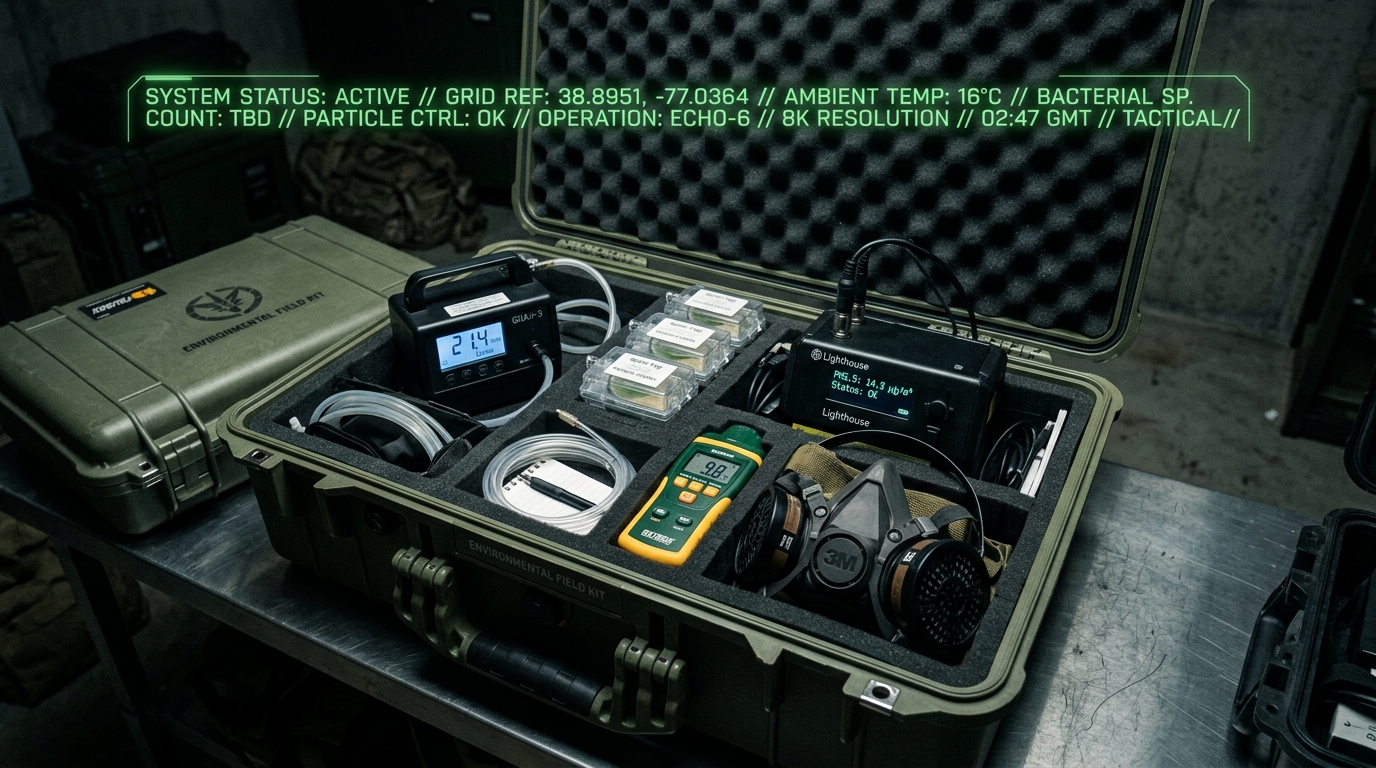
Deployment-Ready Specimen Field Logistics
Standardized containment vessels, cryogenic sample coolers, Teflon-lined tubing, and sterile impaction media prepared for rapid multi-media environmental investigation.
MiniRAE 3000 / ppbRAE
Instantaneous real-time screening for total volatile organic compounds (TVOCs) including benzene, toluene, xylenes, TCE, and PCE. Calibrated with certified isobutylene gas.
Industrial Scientific MX4
Continuous combustible gas, toxic gas, and oxygen deficiency monitoring. Essential for OSHA 1910.146 permit-required confined spaces, trenching, and tank inspections.
Met One AEROCET 531S
Laser diode light scattering measuring airborne aerosol mass concentrations from 0 to 1,000 µg/m³. Validates negative air HEPA machine containment efficiency.
Buck Bio-Aire / Z-Lite
Precision continuous flow pump paired with secondary digital rotameters to collect calibrated air volumes onto trace-calibrated spore cassettes (Air-O-Cell, Allergenco-D).
Larson Davis Spark Dosimeter
Occupational noise dosimetry verifying compliance with OSHA 29 CFR 1910.95 Hearing Conservation standards. 1/1 octave band frequency breakdown for targeted acoustic control.
FLIR E8-XT • Tramex CME5
Non-destructive radiometric thermal imaging combined with deep electrical impedance scanning to pinpoint interstitial structural leaks, insulation voids, and latent microbial wet spots.
THE IN-HOUSE ANALYTICAL BENCH (TDLR LAB #1050)
Most field consulting firms package samples and wait days for subcontracted third-party laboratory reads. Envirogyn environmental technicians are coupled directly to our in-house accredited environmental microbiology laboratory (TDLR LAB #1050 / AIHA-LAP EMLAP), delivering rapid, forensic specimen processing under unbroken custody.
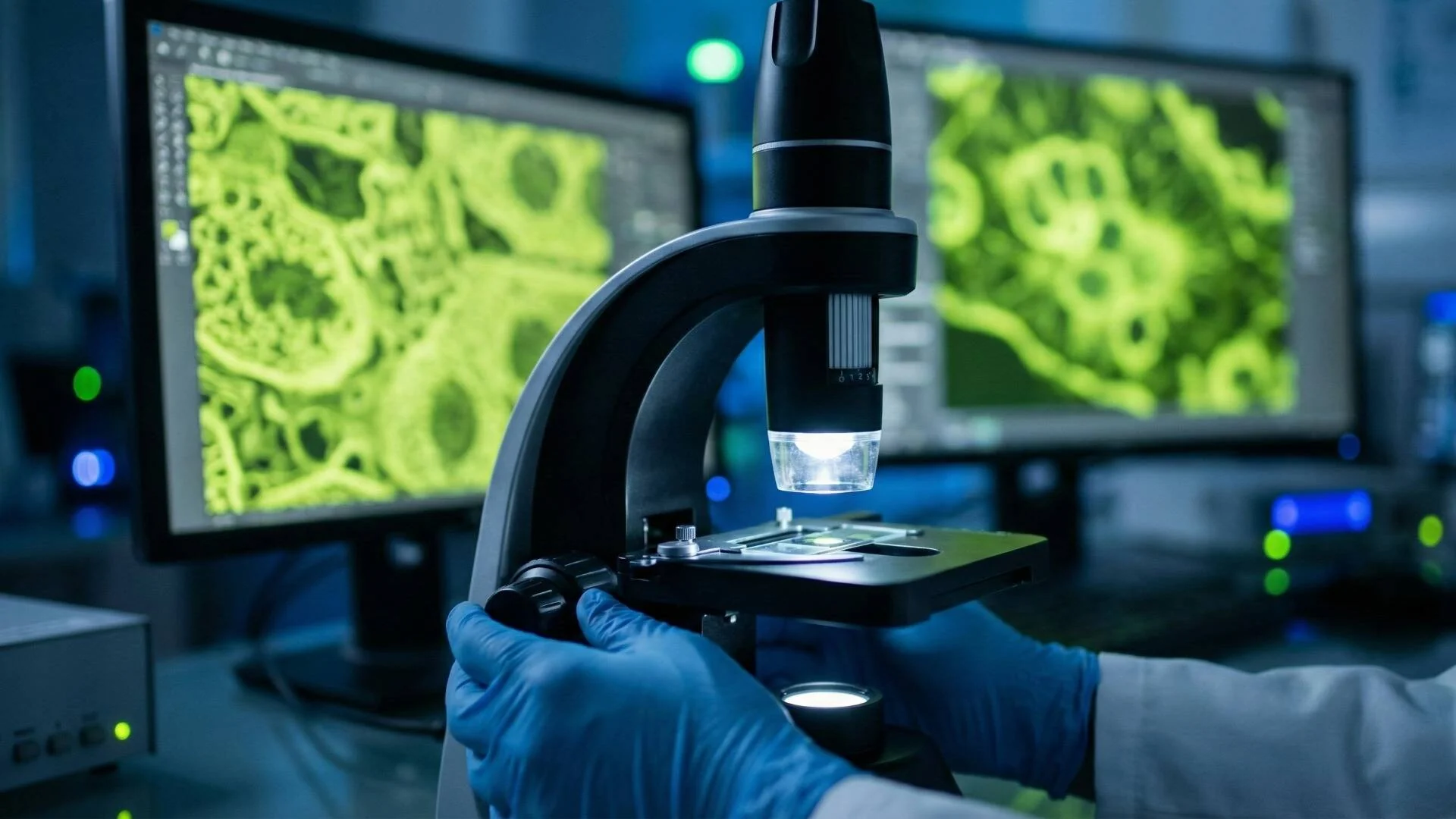
400x to 1000x Oil Immersion Diagnostics
Olympus BX53 research-grade optical microscope with high numerical aperture plan-achromat optics, phase-contrast condensers, and digital reticle micrometer calibration for microscopic fungal structure taxonomy.

Forensic Correlation & Statistical Modeling
Cross-correlating real-time optical particle counts with biological spore densities, psychrometric moisture loads, and historical meteorological data to build court-defensible causation models.
Zero 3rd Party Hand-Offs
Specimens collected by Envirogyn technicians are transported directly in secure, temperature-monitored field lockboxes to our Houston facility, preventing lost packages and broken chains of custody.
ASTM Spore Atlas Alignment
Morphological identification across 35+ fungal taxa, distinguishing water-damage indicator molds (Stachybotrys, Chaetomium) from ubiquitous outdoor phylloplane fungi (Cladosporium, Alternaria).
2-Hour & Same-Day TAT
When real estate transactions or critical industrial shutdowns hinge on environmental clearance, our integrated laboratory delivers expedited preliminary reads within 2 hours of sample intake.
PUBLIC HEALTH SURVEILLANCE & OCCUPATIONAL COMPLIANCE
Environmental Protection Technicians (Including Health) operate under strict federal and state regulatory frameworks designed to safeguard building occupants, industrial workers, and surrounding communities from hazardous chemical, physical, and biological agents.
Permissible Exposure Limits Monitoring
Personal breathing zone (PBZ) and area air surveillance to evaluate employee exposure against 8-hour Time-Weighted Average (TWA) Permissible Exposure Limits (PELs), Short-Term Exposure Limits (STELs), and Ceiling limits for airborne dusts, chemical mists, and hazardous organic vapors.
Hazardous Waste Operations & Emergency Response
Certified technicians trained to establish perimeter control zones, maintain continuous air monitoring, execute decontamination procedures, and safely handle uncontrolled hazardous substance emergencies and legacy industrial contamination releases.
National Ambient Air Quality Standards
Fenceline surveillance and community exposure assessment for Criteria Air Pollutants: fine particulate matter (PM2.5), coarse particulate matter (PM10), ground-level ozone, nitrogen dioxide (NO2), and sulfur dioxide (SO2) around construction and industrial perimeters.
Texas Environmental Regulatory Compliance
Full alignment with Texas Commission on Environmental Quality TRRP standards for soil and groundwater protective concentration levels (PCLs), combined with Texas Department of Licensing and Regulation standards for independent mold assessment protocols.
TECHNICAL FAQ: ENVIRONMENTAL TECHNICIAN OPERATIONS
Review frequently asked technical and legal questions regarding our environmental science technicians, field equipment calibration, and industrial hygiene surveillance capabilities.
1. What distinguishes an Environmental Protection Technician (Including Health) from a general field sampler? +
2. What OSHA certifications and medical surveillance programs govern Envirogyn technicians? +
3. How does real-time photoionization detection (PID) complement laboratory analytical testing? +
4. How is physical and digital Chain of Custody (eCoC) defended against evidentiary challenge? +
5. What role do environmental technicians play during post-remediation verification (clearance)? +
DEPLOY DEFENSE-GRADE ENVIRONMENTAL SURVEILLANCE
Direct tactical deployment across Houston, Galveston, the Energy Corridor, and industrial facilities statewide. Real-time multi-gas detection, calibrated bioaerosol sampling, and court-defensible forensic intake coupled directly to our in-house accredited laboratory.